Menus, signage and customer communications are part of the interior experience. When they work with the surrounding environment, they can make an offer easier to understand, support smoother passenger journeys and give food and beverage spaces a clearer identity.
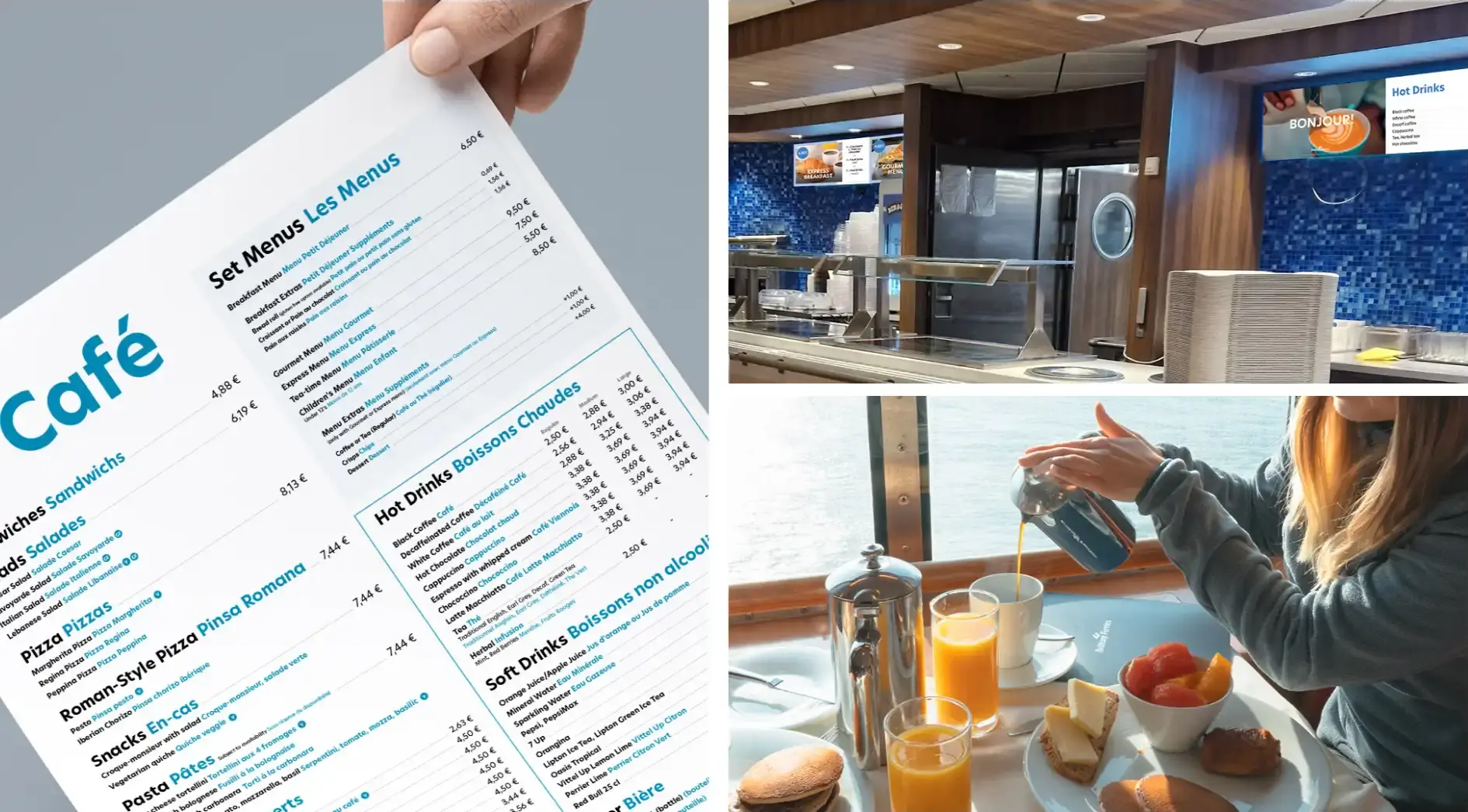
WDC Spaces worked with Brittany Ferries to refresh the menu systems within its onboard self-service restaurants and coffee shops. The project focused on more than graphic presentation. It considered how each touchpoint could support the space around it, communicate the quality of the offer and help passengers make decisions more easily.
A passenger does not experience a menu, sign or counter graphic in isolation. Each element is encountered as part of a wider sequence: approaching the venue, understanding what is available, deciding where to go, placing an order and finding a place to sit.
When these touchpoints feel disconnected from the interior, the experience can become harder to navigate. Important information may be overlooked, the offer can feel less distinctive and the environment may not communicate the quality behind it.
Effective brand touchpoint design creates a stronger relationship between:
The aim is not to add more communication. It is to make every guest-facing detail work harder.
For Brittany Ferries, the self-service restaurants and coffee shops needed communication systems that felt appropriate to the ships, the brand and the needs of passengers in transit.
The revised menu designs were developed to complement the surrounding interiors rather than compete with them. Colour, typography, imagery and hierarchy were considered in relation to the service areas, helping the information feel like an integrated part of the venue.
This creates a more coherent experience. Passengers should be able to move from the wider ship into a dining space and immediately understand its purpose, atmosphere and offer.
That connection is particularly important within marine interiors, where venues sit within a larger passenger journey and may need to communicate clearly across different languages, ages and levels of familiarity.

Clear communication can reduce friction at the point of choice.
The menu systems were designed to improve legibility and make the selection process more intuitive. Information hierarchy, spacing and visual structure help passengers scan the offer, compare options and make decisions without unnecessary effort.
This can also support the operation. When menus are easier to understand, service teams may spend less time clarifying basic information, queues can move more confidently and the ordering experience can feel better organised.
Accessibility was therefore considered as part of the design approach rather than as an additional layer. The role of the menu was to communicate clearly while remaining consistent with the wider brand and interior.
Brittany Ferries’ food and beverage offer has a distinct character, shaped by carefully selected dishes, regional influences and the brand’s French heritage.
The communications needed to make that value more visible.
Without the right presentation, a considered food and beverage offer can be perceived as purely functional. Onboard dining risks becoming something passengers use only because it is available, rather than a destination they actively choose.
The refreshed touchpoints help communicate the care behind the offer. Imagery, language and layout provide more context around the food, supporting a stronger sense of quality and making the restaurants and coffee shops feel more purposeful within the ship.
This is where brand touchpoint design becomes part of interior design. It helps shape how the space is understood, not simply how information is displayed.
Consistency is especially important when communications appear across several vessels, venue types or service formats.
A successful brand touchpoint system needs enough structure to remain recognisable while allowing for different menus, dimensions, operational needs and physical locations.
This requires a flexible design language rather than a single fixed layout. Typography, imagery, tone of voice, information hierarchy and graphic principles need to work together as a practical system.
When these elements are clearly defined, future updates can be made more efficiently and with less risk of the brand becoming diluted over time.
Menus and signage should not be treated as final additions once the interior is complete. They influence how customers understand and use the space, so they need to be considered alongside layout, materials, lighting, service flow and customer journeys.
The strongest guest-facing communications:
Every touchpoint should have a clear role within the experience.
From menus and environmental graphics to wayfinding and onboard communications, we develop practical systems that can be applied consistently and updated as the offer evolves. Reviewing how your guest-facing communications work within your space? Talk to us.
Created on
February 14, 2024
Last updated on
July 22, 2026