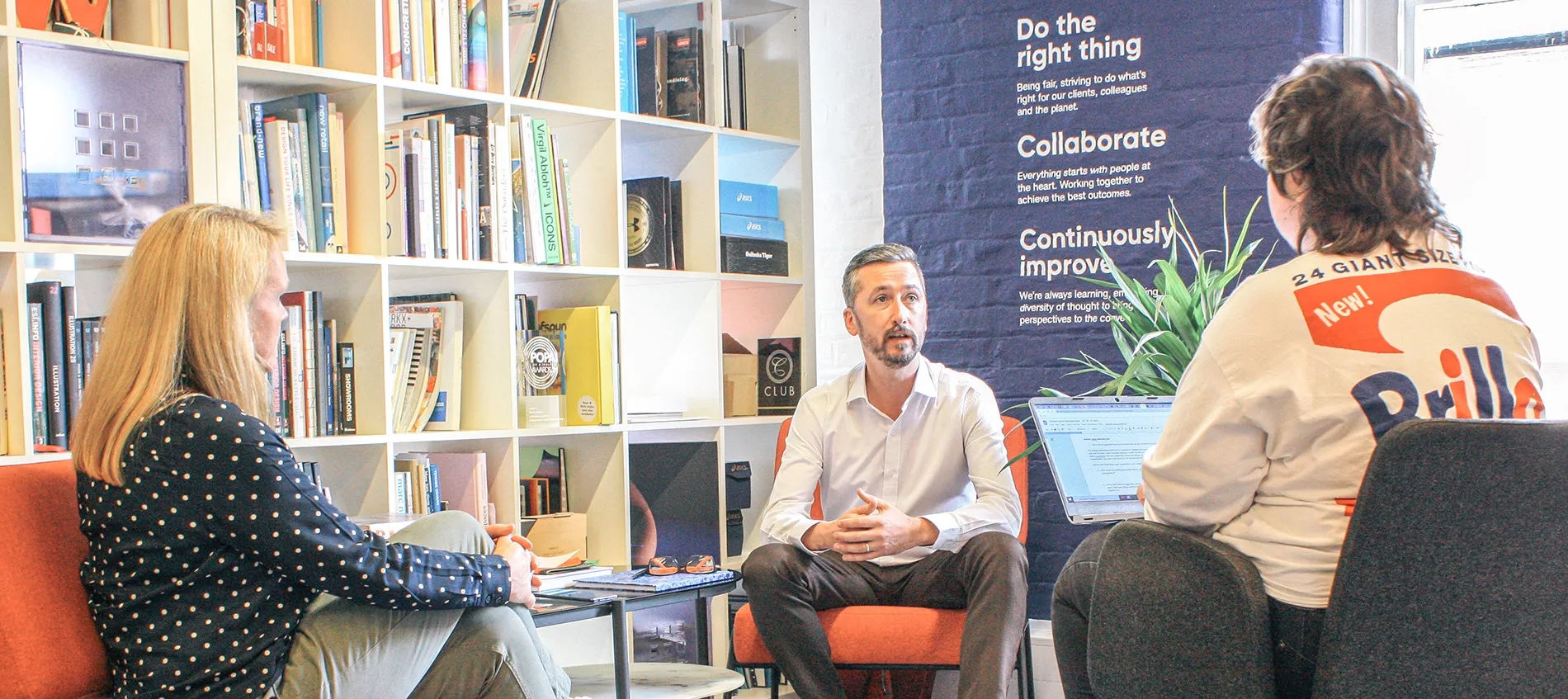
Most sustainability briefs start with the spec sheet: which material, which finish, which supplier. Richard Joyce, founder of Realitree Limited and formerly Design and Technical Director at Quantum 4, starts at the opposite end of the process, the day a fixture gets stripped out. At the time of this interview, Richard was drawing on more than twenty years’ experience detailing sustainable fitouts for retail, leisure and hospitality brands. We spoke to him about carbon offsetting, greenwashing, and why a beautifully specified chair still fails if nobody can take it apart on site.
“Consumers are starting to demand sustainability”
Quantum 4 is an independent technical design agency that works with brands and retailers to develop creative technical solutions.
Its approach is independent from factories and specific methods of manufacture. Rather than starting with a fixed material, supplier or production route, the team focuses on understanding each client’s intentions and requirements, then creating solutions that can be taken to tender. This helps brands and retailers achieve best value and the right outcome for their needs, without being steered towards a solution shaped by a particular factory, machine or material.
“Design is only part of the picture”
Sustainability has been part of Quantum 4’s thinking since the business began. As the company marked its 20th anniversary, that long-term commitment was a key part of its story. I explained that clients were increasingly seeing sustainability not as an added cost, but as something that can create value. As consumer expectations continue to shift, more high street brands are looking for specialist partners who understand the full picture of sustainable retail design and delivery.
Sustainable retail design starts before a fixture is made, with a clear plan for use, maintenance, repair, reuse and end-of-life disassembly.
Sustainability is not just about choosing better materials. It is about designing retail fixtures with longevity, modularity and disassembly in mind. That means standardising parts and fixings where possible, reducing waste, selecting materials that suit the intended lifespan of the fixture, and creating detailed installation, maintenance and operational guides to support long-term use.
Design for disassembly improves recovery, reuse and recycling. In some cases, designing for reuse allows fixtures to be repurposed for a second life.
Wider project decisions also matter. Lower-energy manufacturing, recycled content, reduced virgin material use and responsible waste management all improve environmental performance.
Sustainability thinking has evolved. While embodied carbon remains important, it is only part of the picture. Materials must also be assessed for recyclability, toxicity, landfill impact and end-of-life use.
“If we design for disassembly, then we’re allowing for the management of a material at the end of its life”
Quantum 4’s measurement tool, Quantum Zero, helps brands assess the true environmental impact of fixtures and store designs.
Quantum Zero also considers recyclability, accredited timber, recycled content, embodied carbon, disassembly and lifespan. Available at fixture and store level, it supports more informed, transparent decisions in sustainable retail design.
This is where greenwashing can become an issue. Too often, people compare materials in different ways. Quantum Zero creates a standardised approach, using BREEAM Ecopoints to compare materials such as polymers and metals on the same scale.
It looks at key factors including recyclability, recycled content, embodied carbon and wider environmental impact. But the measurement does not stop at individual fixtures. A well-designed, sustainable item can still sit within a less sustainable store, so the same thinking needs to extend into store planning and full interior fit-out.
Quantum Zero adds another layer of understanding beyond building construction. It helps brands assess the fixtures, furniture and interior elements that shape the overall sustainability of a retail space.
“I am a big fan of innovation and elegance in solutions, and of building efficiencies into processes”
Designing for disassembly is also key. If timber is bonded to metal, for example, those materials can be difficult to separate at end of life and may end up in landfill. By considering disassembly from the start, each material can be managed, reused or recycled more effectively. That retains commercial value for brands and delivers a better sustainability outcome.
I am a big fan of innovation and elegance in solutions, and of building efficiencies into processes. There are three key areas that really feed my interest at the moment. AI generative design, Additive manufacturing, and mono-materials.
AI generative design massively disrupts the standard approach to engineering and builds in multiple layers of efficiencies into your project timeline. Using a combination of AI and machine learning, an engineer can validate designs during the development process, reduce repetitive tasks and save huge amounts of time that allow a quicker route to market but also increase time available to innovate.
Mono-materials will be utilised to allow different material characteristics to be employed from the same baseline material. Imagine building an item of furniture where the structure, the foam and the fabric were all part of the same circular recycling stream? There would be no need to disassemble at the end of life; circular design can be achieved in a very elegant way, with end-of-life planning and management at the very heart of the entire process.
“By planning sustainable goals early in the process, they become part of the design DNA”
When these two approaches are then combined with additive manufacturing, the stakes are raised yet again: zero waste manufacture, from efficient and optimised design, with full circularity and end of life management where you can fully realise the intrinsic value of your materials, or potentially use them again for your next product.
Arizona State University have an excellent presentation by Prasad Boradkar on the topic of “What is Sustainable Design?: Understanding Design” I recommend spending 24 minutes of your life watching this.
If you prefer to read, then “No. More. Plastic.” By Martin Dorey is an excellent guide to turning 2 minutes of your time into a high-value ecological action.
Plan for sustainability
Before I jump into a design, I like to look at the key challenges and plan accordingly. Only when I have the correct solution worked out on paper, will I start to model it up and add the fine detail – I find that when you arrive at a problem during the design process, it can often lead to compromising on either the form, function, or sustainability. By planning specific sustainable goals early in the process they become part of the design DNA and as important as other elements of the design. I make sure I factor in design for disassembly always, and for specific projects that allow, standardisation and modularity. It doesn't cost more to do and can lead to a very efficient manufacturing phase, which in turn brings the project to market sooner at a cheaper cost.
Understand your materials and their true story
No matter how we dress it up, many plastics will degrade during the recycling process and eventually, within a few cycles, will end up as landfill. Look at the true circularity of materials and try to use them accordingly. Look at where products must travel to be recycled – sometimes it's a long, carbon-loaded journey to get the material back to its recycling centre. Equally, look at material availability. In the critical path of a live project, decisions must be made on the fly. If you specify a material that cannot be found in the market or procured in time, then that material will be substituted for something that can be found and you will have lost control of the design and its sustainable credentials.
Communicate
Often details get lost in translation or forgotten as projects go through the various departments. Communicate your intentions to your peers and other stakeholders and get them to buy into the sustainable journey. Sustainability is something to be celebrated and is increasingly expected by consumers. Encourage the adoption of sustainable principles and processes into your company's culture and measure yourselves on it! For too long, sustainability has been a sacrificial ideal and perceptions need to change to ensure that we all understand that small changes can make massive differences to ourselves and future generations.
Yes, very much so. We're being engaged more and more by clients that want to go on a responsible journey. Aside from their own desire to do the right thing, more and more consumers are demanding it, and they'll potentially see the impact on their sales if their brand isn't seen to be a responsible brand. Outside the realm of sustainability, we want to see ethical companies. We want to buy from ethical brands - the way they treat humans and the way they treat the environment or animals. It's about welfare, it's about wellbeing."
"Ultimately, it comes down to planning. The sooner that you start planning for sustainability, the sooner you're going to benefit from it. You can change your design approach to make something more sustainable, and through practice and application that becomes the new standard. Really, sustainability is about raising standards. It's not just in the choice of materials, it's in how you use those materials. It's in the design of the form and the function, so that those materials play to their strengths and are combined in a way that allows you to deal with them responsibly at their end of life. If sustainability is an afterthought, it will have the value of an afterthought.
“The sooner that you start planning for sustainability, the sooner you’re going to benefit from it”
WDC Spaces designs and details retail, leisure and marine spaces engineered for the full lifecycle, not just the launch. Bring us your next brief. Get in touch.
Created on
May 26, 2022
Last updated on
July 7, 2026